
Product guidance
Email Verification in Spring Boot: Moving Beyond Syntax
Learn how to implement service-layer email verification in Spring Boot, moving beyond syntax checks to evaluate real-time mailbox deliverability.
Learn how to implement service-layer email verification in Spring Boot applications, moving beyond basic syntax annotations to evaluate real-time mailbox deliverability.
Standard email validation in Spring Boot typically uses Bean Validation annotations like @Email to confirm string formatting. To maintain reliable contact records, engineering teams must move beyond static formatting and integrate service-layer deliverability verification. Incorporating this check into Spring Boot services helps applications identify non-viable addresses before committing them to persistent storage, supporting long-term data quality without interfering with standard application architecture.
The Limitations of Syntax-Only Validation
Spring Boot applications frequently validate user inputs at the controller or Data Transfer Object (DTO) layer. Annotations such as Hibernate Validator's @Email inspect input strings against formal patterns defined in RFC 5322: Internet Message Format. This validation confirms that an address contains expected structural tokens, such as a local part, an at-sign, and a domain label.
While structural checks filter out malformed strings like missing domain components or disallowed characters, they operate without awareness of the underlying mail infrastructure. A syntactically valid string such as user@exampleinvalidmailbox123.com easily satisfies standard regular expressions. Consequently, systems that rely exclusively on format validation remain vulnerable to storing non-functional mailboxes, leading to accumulated invalid entries in persistent data stores.
Evaluating Deliverability at the Service Layer
Transitioning to robust data verification involves evaluating reachability at the application service layer.
A completed Email Deliverability Check returns a precise signal: the address is either deliverable, meaning it can receive mail at check time, or undeliverable.
The verification process maintains clear operational boundaries:
- Deliverable: The target address is capable of receiving messages at check time.
- Undetermined: Catch-all configurations return an undetermined status rather than an inferred classification.
Checks send no outbound messages to the recipient and omit notifications to the address holder, preserving operational discretion during review workflows.
Designing Spring Boot Verification Architectures
In a clean Spring Boot architecture, validation responsibilities should be divided across layers. DTO validation annotations should handle preliminary lexical filtering, while service components handle network-based deliverability lookups.
For interactive workflows, such as user registration or profile updates, a service can execute a synchronous call using POST /api/v1/check for a single record, or POST /api/v1/batch-check when processing small collections of up to 100 addresses. When a user submits registration details, the service layer first evaluates the format, invokes the deliverability endpoint, and determines whether to persist the record.
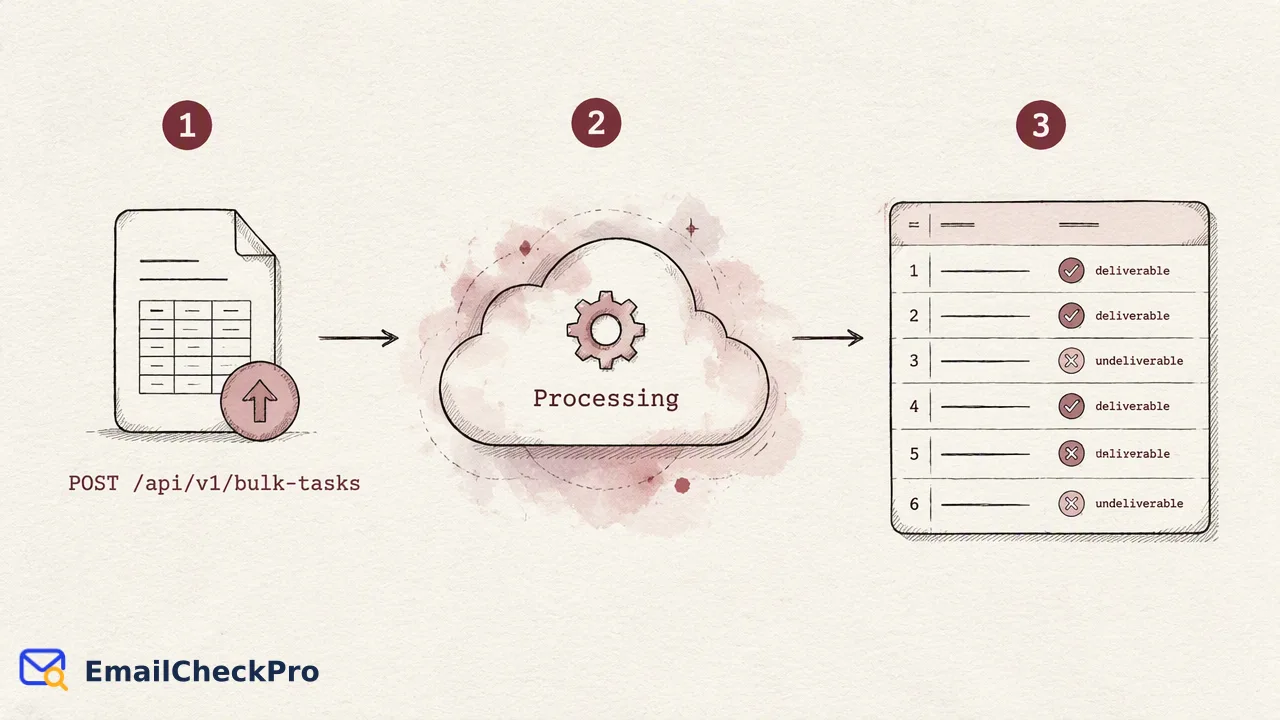
For bulk imports, list migrations, or administrative uploads, Spring Boot services should implement asynchronous file-based processing. Submitting files via POST /api/v1/bulk-tasks offloads intensive evaluation, while scheduled workers query GET /api/v1/bulk-tasks/{id} until the task completes. Applicable per-product limits apply; developers should consult the official API documentation for current volume specifications. This decoupled architecture isolates long-running verification jobs from interactive user requests, sustaining responsive web performance across the application.
Balancing Application Latency and Data Quality
Integrating external network checks into user-facing operations requires balancing processing latency against data accuracy requirements. Executing synchronous API calls within the HTTP request cycle introduces network overhead that can affect response times if unmanaged.
Teams can optimize this trade-off by configuring reasonable client timeouts and designing graceful fallback pathways. For example, if a verification endpoint encounters a network interruption or reports an undetermined catch-all state, the service can flag the record for asynchronous review rather than failing the registration outright.
Additionally, enterprise systems must align their data collection practices with privacy principles. Under GDPR Article 5 (Regulation (EU) 2016/679), personal data collection must remain adequate, relevant, and limited to what is necessary for specified purposes. Verifying deliverability helps systems avoid accumulating stale or non-deliverable personal records, assisting engineering teams in maintaining lean, compliant data architectures while preserving swift user interactions.
FAQ
Why does an application experience delivery failures after passing @Email validation?
Hibernate Validator's @Email annotation confirms only that an input string conforms to RFC syntax rules, such as containing a local part, an at-sign, and a domain. To identify invalid or non-existent mailboxes, applications must perform a deliverability check at check time.
How should Spring Boot applications handle catch-all domains during verification?
In verification services like EmailCheckPro, catch-all addresses return an undetermined status rather than an inferred deliverable or undeliverable verdict. Spring Boot applications should route undetermined catch-all outcomes to secondary review queues or business logic rules, avoiding arbitrary rejection.
Learn More
Choose the product information that fits the next step in your workflow.