
Product guidance
Why Client-Side Email Validation Isn't Enough: Moving to Service-Layer Verification
Discover why client-side checks fail and how a service-layer email verification workflow protects data integrity across web, API, and batch entry points.
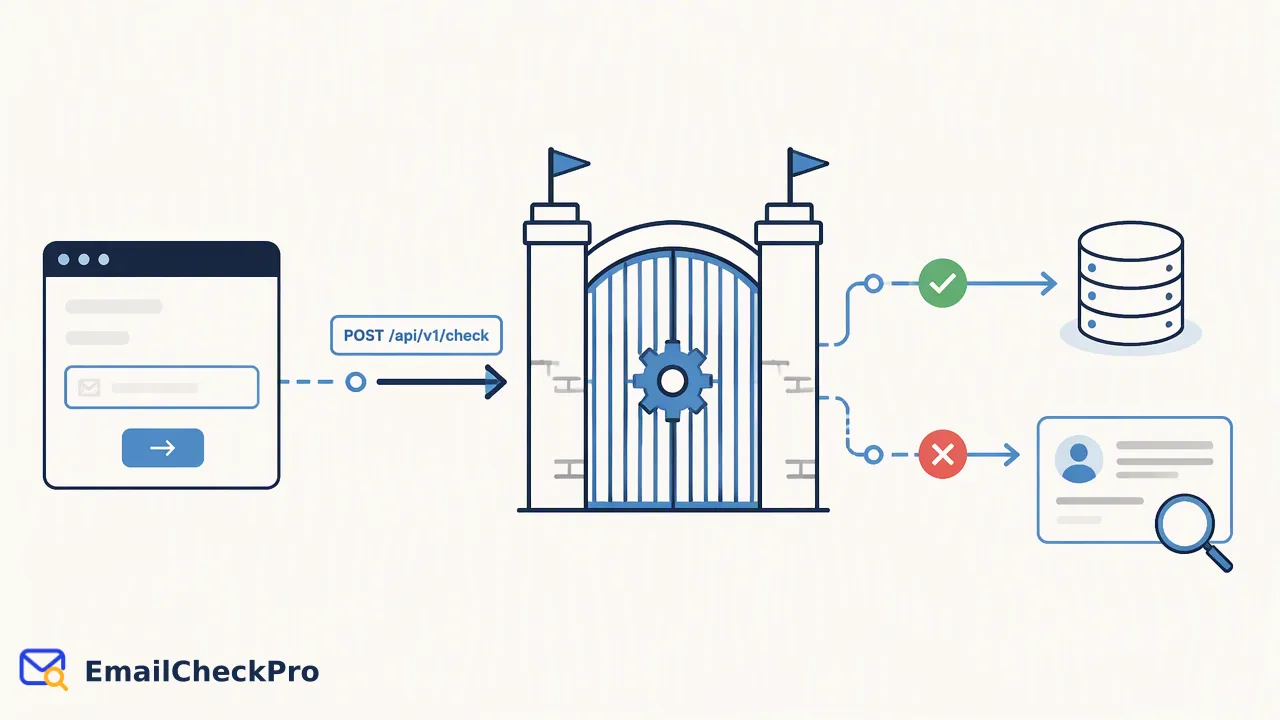
Client-side validation improves user experience but fails to protect databases from invalid contacts. Centralizing checks at the service layer creates a resilient email verification workflow across all entry points.
Client-side validation functions primarily as a user experience mechanism rather than a data integrity boundary. Browser-level syntax checks intercept simple typographical mistakes, but they cannot verify whether an address exists at its mail provider or can receive messages. Furthermore, client-side scripts are easily bypassed by direct API calls, automated submissions, or data imports. Establishing an effective email verification workflow requires moving validation into the service and persistence layers. By evaluating provider-level reachability signals during data ingestion, organizations maintain uniform record quality across every entry point while gathering timely data to inform downstream outreach and contact governance.
The Limitations of Client-Side Validation
Browser-based validation relies on regular expressions or standard HTML5 form attributes to inspect text strings. Client-side checks operate entirely within the user's local browser environment, making them vulnerable to circumvention via scripts, disabled browser controls, or direct HTTP requests to unsecured form handlers. In addition, framework-level regex validators frequently lag behind evolving domain standards or become overly permissive. A syntactically valid string satisfies client-side pattern rules but fails to represent a reachable contact. Treating form-level format compliance as proof of record validity introduces invalid contacts into downstream databases. To protect data hygiene, technical teams treat client-side validation purely as an interactive interface convenience and delegate record evaluation to backend workflows.
Centralizing Logic at the Persistence Layer
Modern application architectures ingest contact data from multiple sources, including web forms, mobile applications, partner integrations, REST interfaces, GraphQL endpoints, and bulk CSV uploads. If validation logic resides in isolated front-end components, each integration pathway risks applying inconsistent validation standards, leading to maintenance drift and corrupted customer records. Centralizing validation at the persistence layer—such as through backend service interceptors, repository middleware, or database pre-save hooks—ensures consistent enforcement across every inbound channel. When a record arrives via an API payload or batch import, the persistence layer applies identical verification rules before committing data to storage. This unified architecture eliminates duplicate validation logic across separate client repositories and establishes a reliable data gatekeeper for all operational datastores.
The Role of Real-Time Service-Layer Verification
Moving validation to the service layer allows systems to incorporate real-time provider checks directly into the data ingestion lifecycle. Format validation confirms structure, whereas service-layer verification queries mail systems at the time of entry to confirm whether the account is registered. In an automated email verification workflow, backend services can leverage Email Check Pro via synchronous single-check requests at POST /api/v1/check or evaluate incoming groups using POST /api/v1/batch-check for up to 100 addresses. For large datasets and data migrations, asynchronous tasks at POST /api/v1/bulk-tasks support lists from 1,000 to 100,000 addresses. Implementing these checks within backend microservices ensures data records are evaluated before entering customer relationship systems.
Handling Complex Data Scenarios and Edge Cases
Recognizing an undetermined signal helps teams route ambiguous records to secondary review pipelines, manual inspection, or specialized verification workflows. Incorporating clear handling rules for undetermined and invalid statuses within the persistence layer protects internal databases from unverified contacts and ensures consistent treatment across automated pipelines.
FAQ
Why is client-side validation insufficient for data integrity?
Client-side validation only verifies basic syntax against pattern rules in the browser. Relying on front-end checks allows invalid and non-existent addresses into databases, making server-side verification necessary for maintaining uniform data standards.
What is the difference between syntax validation and registration verification?
Syntax validation examines string formatting against predefined regular expressions, ensuring standard elements like domain names and symbols are present. Registration verification checks whether an account is actively registered at the host provider.
How should teams handle catch-all domains in an email verification workflow?
Verification queries return an undetermined status rather than guessing a registration state. Teams should route undetermined records into secondary validation workflows, flagged lists, or manual review stages rather than treating them as confirmed accounts.
How does persistence-layer validation prevent maintenance drift?
Embedding validation rules in client-side code requires replicating logic across web apps, mobile apps, and administrative panels. When rules change, disparate codebases often fall out of sync. Centralizing verification at the persistence layer enforces identical rules across REST endpoints, GraphQL queries, and administrative imports from a single backend location.
Learn More
Choose the product information that fits the next step in your workflow.