
Product guidance
Deliverable vs Undeliverable Email: Reading Email Check Results
Deliverable vs undeliverable email explained: what each result means at check time, what it does not prove, and how to act on both in a list workflow.
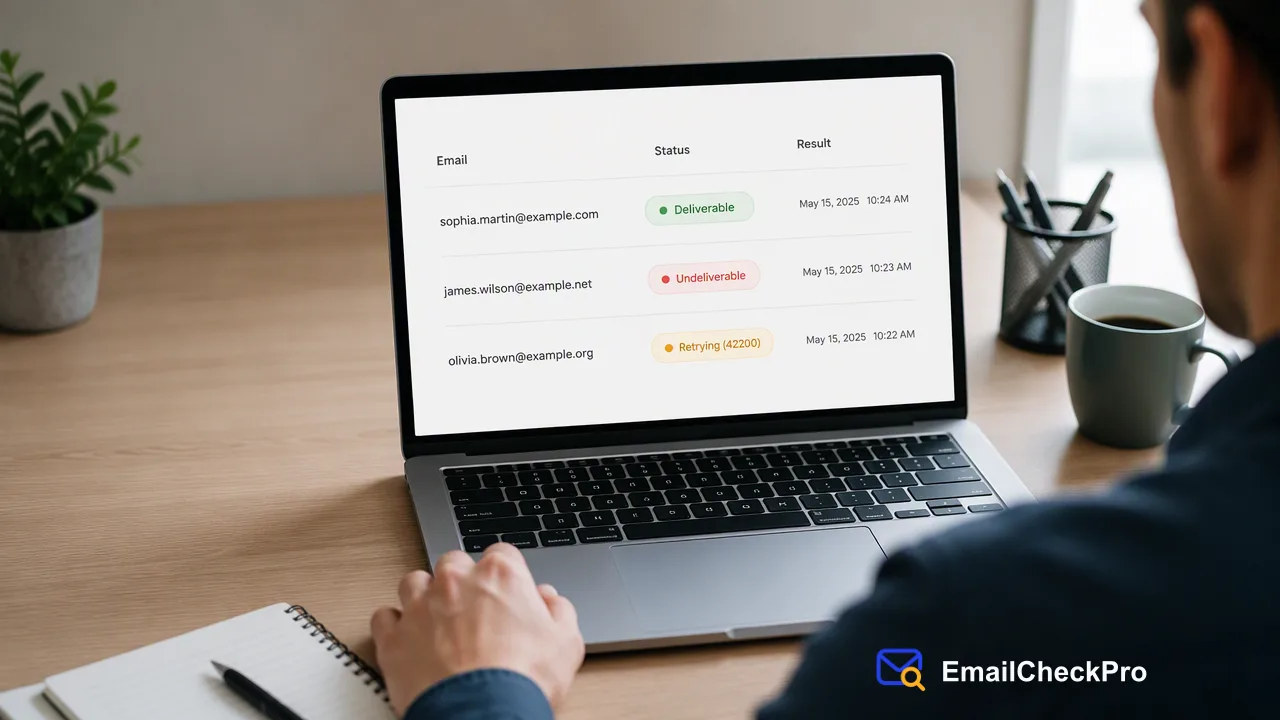
Deliverable means an address could receive mail at check time; undeliverable means it could not. Neither proves inbox placement, consent or identity.
A deliverable result means the address was able to receive mail at the moment of the check. An undeliverable result means it was not. Both are completed answers about that moment only. They do not predict inbox placement, a reply, or how the address will behave next month. Used correctly, the two outcomes help a team decide which addresses are worth sending to and which should be fixed or suppressed before a campaign goes out.
Deliverable vs undeliverable email: the two outcomes
EmailCheckPro's Email Deliverability Check speaks in two completed outcomes. In the API, registered=true marks a deliverable address and registered=false marks an undeliverable one. The site's wording is simply deliverable and undeliverable, and that is the vocabulary to use in reports and CRM fields.
Both outcomes are completed, billable results at the product rate. That surprises some teams, who expect only good addresses to count. An undeliverable verdict is useful information: it tells you to stop spending effort on that row.
The check sends no message and does not notify the address owner. It answers a question about reachability, not about the person behind the address.
What a deliverable result tells you
Deliverable means the address could receive mail when it was checked. That is a solid reason to include the row in a send, but it has clear edges.
- Time-bound. Mailboxes get closed, filled and renamed. The result describes check time, so older results lose value; recheck lists that have sat for a while before a large send.
- Not inbox placement. An address that can receive mail may still route a message to spam or a promotions tab. Placement depends on the sender's reputation and content.
- Not consent. Being able to receive mail is not permission to send it. Consent comes from how the contact was collected.
- Not a reply. Engagement is a separate outcome that no check can predict.
Read deliverable as one input into a sending decision, alongside source, consent and recency.
What an undeliverable result tells you
Undeliverable means the address could not receive mail at check time. In everyday email operations this lines up with what senders call a hard failure. That is useful background for why suppression is the normal response, though it is an outside reference and not a description of how EmailCheckPro reaches its verdict.
Practical handling:
- Suppress the row from outbound sends.
- If the address came from a typed form, look for an obvious typo before discarding the contact.
- If a person entered it recently, ask them for a replacement.
- Keep the record with its outcome noted so the same address is not re-imported and re-checked.
Outcomes that are neither deliverable nor undeliverable
A reliable results table has more than two columns. Three further outcomes should never be merged into undeliverable:
| Outcome | Meaning | Charged |
|---|---|---|
| Invalid | Not a complete address, such as a missing @ sign or domain | No |
| Failed | The check did not complete | No |
| Undetermined | A catch-all domain or similar case where no verdict can be given | No |
In the realtime flow, an undetermined case returns code 42200 and no result. In a synchronous multi-address request, an entry that has no completed result is marked as such, and that is different from an undeliverable verdict.
Counting these as undeliverable inflates suppression lists and removes contacts that may be reachable. Keep each outcome in its own column and give each a different next action.
Turning results into a send decision
A simple decision frame works for most teams:
- Deliverable and recently checked: eligible for the send, subject to consent.
- Undeliverable: suppress or correct.
- Undetermined: segment, limit exposure, or use another channel.
- Invalid: return to the source for correction.
- Failed: retry later.
When the result feeds another system, keep the outcome as a plain label such as deliverable or undeliverable together with the date of the check. The date matters as much as the label, because it tells the next person how much weight the result still deserves.
FAQ
Does deliverable mean the email will reach the inbox?
No. Deliverable means the address could receive mail at check time. Where a particular message lands is outside what an address check reports.
How long does a deliverable result stay reliable?
The result describes the moment of the check, and no fixed shelf life is documented. Teams usually recheck lists that have been idle before a large send, and store the check date next to the outcome so the age of every result is visible.
Are undeliverable results charged?
Yes. Both deliverable and undeliverable are completed results and are billable at the product rate, while invalid, failed and undetermined checks are not charged. Refer to the official pricing and API documentation for current rates.
Learn More
Choose the product information that fits the next step in your workflow.