
Product guidance
Integrating Real-Time Email Verification into AI Workflows via MCP
Learn how to integrate real-time email verification into AI workflows using the Model Context Protocol (MCP) to improve data quality and reachability signals.
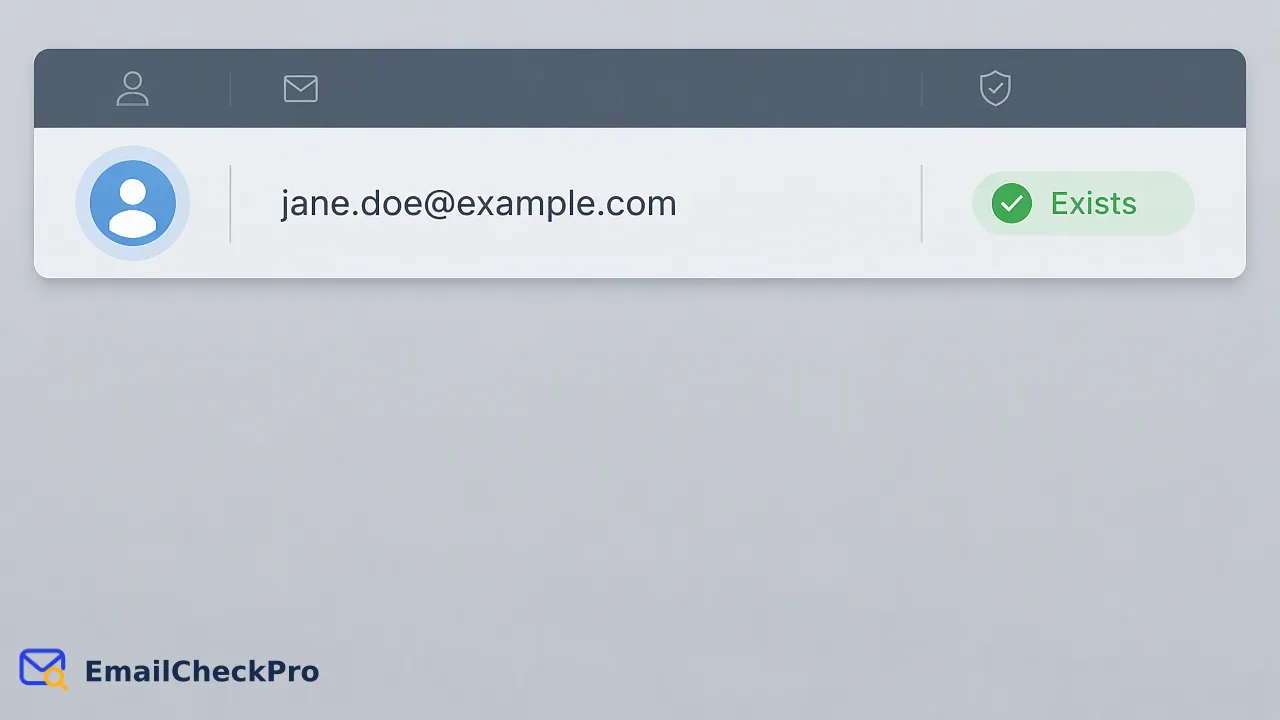
Learn how to use the Model Context Protocol (MCP) to connect AI agents with real-time email verification, improving data-quality workflows without custom API integrations.
Integrating real-time email verification into AI workflows via the Model Context Protocol (MCP) helps AI agents perform data-quality checks directly from their interface. By connecting Email Check Pro to an MCP-compatible client, teams can verify email registration status in real time, confirming contact data is reachable at the point of entry without building custom API integrations. This approach bridges the gap between automated strategy generation and live data validation.
The Role of AI Agents in Data Quality
AI assistants are highly capable when managing high-level outreach strategy, drafting communications, and organizing contact lists. However, these automated systems inherently lack access to live, verified contact databases. When AI agents process unverified data, teams risk incorporating invalid addresses into their data-quality workflows. Integrating real-time verification directly into the AI environment addresses this limitation. By equipping AI agents with the ability to query live registration status, organizations support workflows that rely on accurate reachability signals. This capability shifts the operational focus from manual list building and retrospective list hygiene to proactive data management. Instead of exporting data to separate validation tools, teams can instruct their AI assistants to validate contact information at the exact moment of lead generation or data entry. This seamless data-quality workflow helps teams review contact records efficiently and informs internal decisions regarding outreach prioritization, supporting subsequent automated actions based on verified provider reachability.
Standardizing Connections with MCP
The Model Context Protocol (MCP) standardizes how AI assistants connect to external data tools and services. Historically, connecting an AI model to a live verification service required building and maintaining custom API integrations for every specific tool pairing. MCP acts as a universal connector, removing this custom integration overhead. By adopting this protocol, developers can provide AI agents with a standardized pathway to access external capabilities, such as email registration checks, without writing bespoke middleware. For teams managing email data-quality workflows, MCP supports a direct line of communication between the AI interface and the verification provider. Once the protocol is configured, the AI assistant can autonomously format requests, interpret the verification signals, and apply the results to the current task. This standardized architecture not only accelerates deployment but also means that the AI agent can reliably access real-time data tasks, making the integration of external verification services highly scalable across different AI platforms and internal applications.
Implementing Email Verification via MCP
To implement real-time verification, teams point their MCP-compatible client directly at the Email Check Pro MCP endpoint located at https://emailcheckpro.com/mcp. This configuration helps the AI agent trigger registration checks seamlessly during active sessions. For environments requiring traditional REST architectures, the platform also provides standard API endpoints documented at https://emailcheckpro.com/api-docs. Developers can utilize POST /api/v1/check to process a single address synchronously. When workflows demand higher volume processing in real time, POST /api/v1/batch-check handles up to 100 addresses synchronously. For large-scale list hygiene tasks that fall outside immediate AI chat interactions, teams can utilize asynchronous file tasks via POST /api/v1/bulk-tasks, which supports lists ranging from 1,000 to 100,000 addresses per task. Whether utilizing the MCP endpoint for interactive AI tasks or the REST API for backend processing, the integration supports both standard registration status checks and public-avatar checks, providing flexible deployment options for diverse data-quality requirements.
Understanding Verification Signals
Interpreting the data returned by Email Check Pro requires a precise understanding of the verification signals. This signal confirms that the account exists on the provider's platform. Furthermore, a registered status does not establish inbox placement, sender reputation, or a reply from the recipient. The service also identifies specific domain configurations that affect verification. This explicit categorization helps teams manage list hygiene by isolating domains that accept all incoming mail regardless of the specific local part. By understanding these exact signal boundaries, organizations can accurately incorporate the data into their risk and outreach workflows without overestimating the capabilities of the verification process.
Public Avatar Checks for Supported Providers
In addition to standard registration verification, the integration supports public-avatar checks for specific email families. The Email Avatar Check capability determines public avatar availability alongside the basic registration status. This feature is strictly limited to the Gmail, Yandex, and Mail.ru email families. When an AI agent queries an address belonging to one of these supported providers, the service returns both the email registration signal and the public avatar signal. Teams can use this supplementary data point to inform internal reviews of contact records. However, organizations must apply the same strict interpretation boundaries to avatar data as they do to registration status. Additionally, retrieving this signal does not grant permission to reuse the associated image. The avatar check simply serves as an additional data point regarding the public configuration of the account at the time of the query.
FAQ
What is the benefit of using MCP for email verification?
The Model Context Protocol (MCP) acts as a universal connector that standardizes how AI assistants communicate with external services. By using MCP, teams can connect their AI agents directly to Email Check Pro without building custom API integrations. This helps the AI perform real-time data tasks, such as verifying contact lists during lead generation, directly from the chat interface, streamlining data-quality workflows and reducing development overhead.
Does the registration check establish email delivery?
Which email providers support avatar checks via the integration?
The public-avatar check capability is limited exclusively to the Gmail, Yandex, and Mail.ru email families. When querying addresses from these specific providers, the service returns a public avatar signal alongside the standard registration status.
How does the system handle catch-all email domains?
The system does not guess a registration outcome for these addresses. This precise categorization helps teams accurately manage list hygiene by identifying domains that obscure individual account reachability.