
Product guidance
Beyond the Pixel: How to Maintain Email Deliverability in a Privacy-First World
Learn how to maintain email deliverability and support email tracking privacy compliance using proactive registration checks instead of invasive pixels.
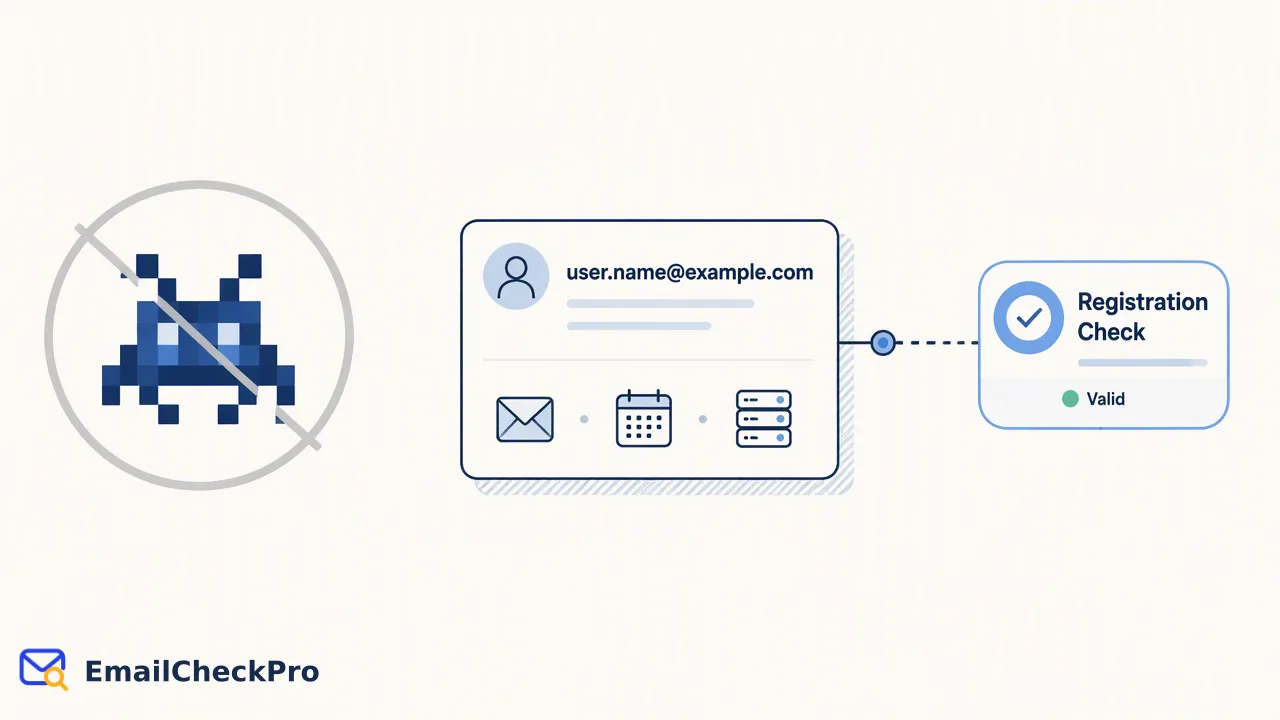
Explore how shifting EU regulations impact email tracking pixels and discover how proactive registration status checks support deliverability and privacy compliance.
As regulators in jurisdictions like France and Italy tighten rules on tracking pixels under GDPR and ePrivacy directives, organizations are shifting away from invasive engagement tracking. Email tracking privacy compliance now requires teams to justify data collection, limit scope, and obtain consent for pixel usage. Verifying email registration status at the provider level offers a privacy-conscious alternative. This method checks whether an account is active and reachable at the time of the check, supporting data-quality workflows without requiring user-level tracking.
The Changing Regulatory Landscape for Email Tracking
Recent guidance from regulators in France and Italy has clarified that email tracking pixels fall under ePrivacy and GDPR rules. These transparent images, traditionally embedded in messages to monitor opens and user behavior, are increasingly classified as accessing information directly from a user's device. Consequently, this classification triggers strict consent requirements. Organizations must now justify their use of tracking technologies, limit the data they collect, and obtain explicit consent from recipients. The regulatory trend is moving firmly toward a "justify, limit, and consent" model for all email-based tracking. This shift means that relying on pixels as the primary method for monitoring list health introduces significant friction. By understanding these regulatory changes, organizations can adapt their data-quality workflows to support compliance efforts rather than depending on outdated, invasive tracking methods.
Distinguishing Marketing Analytics from Deliverability Hygiene
Regulators distinguish between tracking used to profile user behavior and tracking necessary for technical delivery. However, relying on pixels to determine if an inbox is active blurs the line between technical necessity and behavioral monitoring. Instead of waiting for a tracking pixel to fire—which requires the user to open the message and load images—teams can use alternative signals to inform their list management. Shifting the focus from user engagement metrics to proactive data quality helps organizations maintain clean lists.
Proactive List Hygiene as a Privacy-First Strategy
Email Check Pro offers an Email Registration Check that determines whether an email account is registered at its provider at the time of the check. This method catches typos, closed accounts, and addresses that were never real, which are primary causes of bounces. It simply informs teams that the address is reachable at that specific moment. By integrating this signal into data-quality workflows, organizations can filter out invalid addresses before sending any messages.
Implementing Data-Quality Workflows
Integrating registration checks into existing systems requires understanding the specific signals returned by the provider. For individual verifications, teams can use the POST /api/v1/check endpoint, which handles one address synchronously. For slightly larger immediate needs, the POST /api/v1/batch-check endpoint processes up to 100 addresses synchronously. This ensures no false assumptions are made about account validity, allowing teams to route these addresses for secondary review. Additionally, the Email Avatar Check can check public avatar availability alongside registration status for supported Gmail, Yandex, and Mail.ru email families.
Scaling Registration Checks for Large Lists
Organizations managing extensive contact databases require scalable solutions that support email tracking privacy compliance without overwhelming internal resources. For high-volume data-quality workflows, teams can utilize asynchronous file tasks via the POST /api/v1/bulk-tasks endpoint. The Email Bulk Registration Check supports lists ranging from 1,000 to 100,000 email addresses per task, providing asynchronous file-based registration checks. This allows teams to process large historical lists or perform routine hygiene on entire databases efficiently. Similarly, the Email Bulk Avatar Check runs asynchronous file-based public-avatar checks for supported email families within the same 1,000 to 100,000 address volume constraints. By processing these checks in bulk, organizations can systematically identify unreachable accounts and update their suppression lists proactively.
FAQ
How do new EU regulations affect the use of email tracking pixels?
Regulators in France and Italy have clarified that email tracking pixels fall under ePrivacy and GDPR rules. Because pixels access information from a user's device, they trigger strict consent requirements. Organizations must now justify their use, limit data collection, and obtain explicit consent. This regulatory shift means teams evaluating email tracking privacy compliance should audit their practices and transition toward privacy-first data-quality workflows rather than relying on invasive behavioral tracking.
Can organizations still track email opens for deliverability purposes?
However, the overarching trend requires organizations to justify and limit data collection. To support email tracking privacy compliance, many teams are replacing open-tracking pixels with proactive registration status checks, which confirm provider reachability without monitoring user behavior or requiring device-level access.
What is the difference between an email registration check and tracking pixels?
A tracking pixel is a transparent image embedded in a message that monitors user behavior, such as opens and device information, triggering ePrivacy consent requirements. In contrast, an email registration check queries the provider to confirm if the account is active at the time of the check.
How does checking registration status help maintain domain reputation?
Checking registration status helps teams identify closed accounts, typos, and addresses that were never real before any messages are sent.
How do registration checks handle catch-all domains?
This precise signal ensures that teams do not make false assumptions about account validity.