
Product guidance
The Seasonal Outreach Myth: Why Data Quality Matters More Than Timing
Discover why email outreach data quality matters more than seasonal timing. Learn how real-time registration checks support list hygiene.
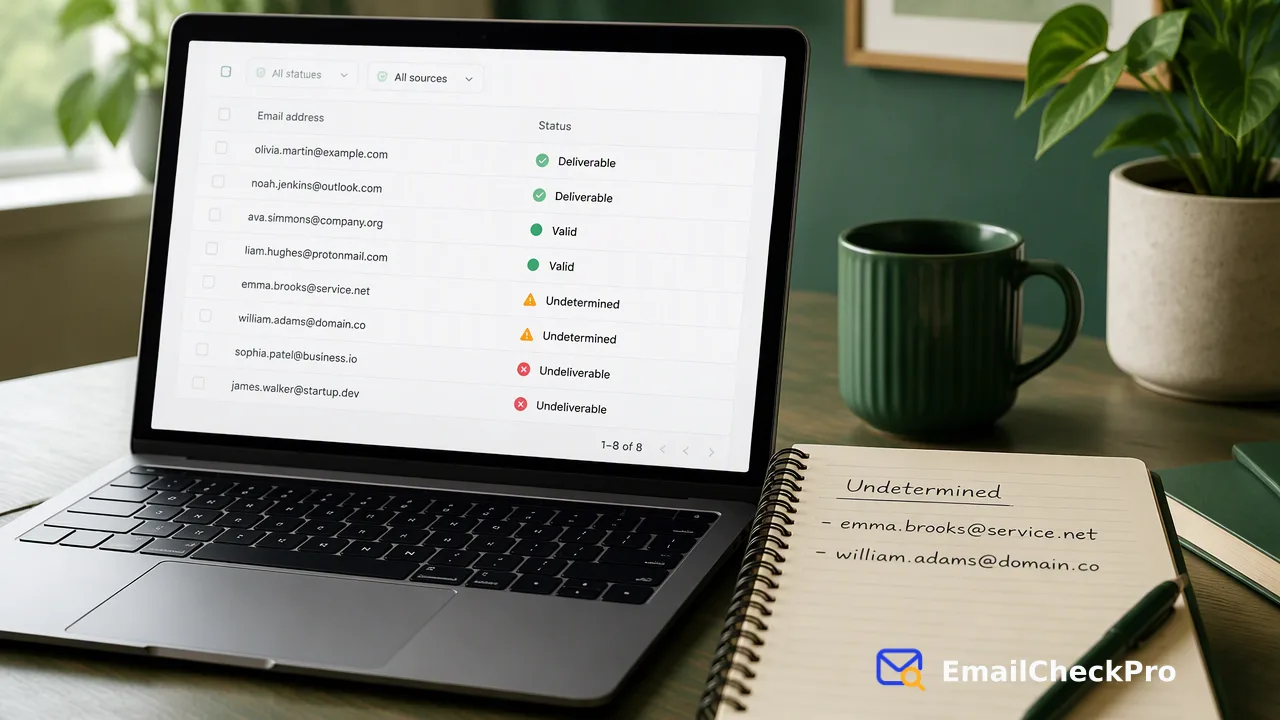
Seasonal email outreach fluctuations are often overstated compared to the operational impact of list hygiene. Verifying provider reachability at check time establishes reliable data quality across campaign cycles.
Seasonal trends in email outreach volume and recipient responses exist, but industry discussions frequently overstate their operational significance. Senders often adjust campaign calendars around holidays or quarter ends under the assumption that timing drives performance. However, aggregate engagement patterns diverge across regions and industries, making calendar-based rules inconsistent. Prioritizing email outreach data quality through provider-level registration checks offers a more dependable foundation for outreach workflows. Verifying whether a recipient account is registered at its provider at check time helps teams filter inactive addresses, address data decay, and maintain clean lists regardless of seasonal shifts.
The Disconnect Between Seasonal Calendar Timing and Recipient Behavior
Many outreach plans depend heavily on seasonal calendars, anticipating distinct quiet periods during summer months, winter holidays, or financial year boundaries. While aggregate email volume shifts during these periods, recipient responsiveness does not uniformly mirror sending volume. In many sectors, reply volumes peak when outbound activity slows, whereas heavy sending periods can coincide with lower relative attention. Furthermore, broad seasonal benchmarks flatten critical regional differences. Outreach cadences across the Americas, EMEA, and APAC operate under distinct cultural calendars, holiday schedules, and commercial cycles. An assumption that August represents an outreach lull applies in parts of Europe but fails in markets maintaining standard operations. Relying on generalized seasonal timing often introduces operational friction without addressing core contact quality.
Why Ongoing List Hygiene Outperforms Calendar Adjustments
Attempting to optimize outreach performance by shifting send dates overlooks the continuous reality of contact data decay. Contact databases naturally degrade as individuals change jobs, organizations alter domain structures, and abandoned accounts close. A contact list paused for a seasonal window still experiences decay over that downtime. Focusing on email outreach data quality directly addresses the validity of the recipient list. Rather than hoping a holiday lull improves recipient receptivity, teams maintain list integrity by verifying account presence. Verifying data inputs before scheduling campaigns helps isolate invalid syntax, expired accounts, and non-existent domains, establishing an objective baseline for contact management that seasonal adjustments cannot provide.
Evaluating Real-Time Provider Reachability Signals
Modern data-quality architectures rely on real-time provider checks rather than static syntax filters. Understanding the scope of this signal is essential for technical implementations:
- Provider Reachability Signal: A positive verification indicates that the email address is actively provisioned on the host mail system when queried. - Error Screening: Integrating this check helps data pipelines remove common typographical errors and dormant user addresses before records enter CRM sequences.
Managing Catch-All Domains and Undetermined Results
In these scenarios, standard verification checks return an undetermined outcome rather than an inferred positive or negative status. Acknowledging undetermined records preserves data transparency. Systems should not treat undetermined accounts as confirmed active mailboxes. Instead, technical workflows can route undetermined addresses to dedicated verification queues, secondary enrichment checks, or manual review pipelines, preventing unverified records from corrupting main distribution lists.
Technical Integration Workflows for Contact Verification
Teams can embed email registration checks across different stages of data ingestion and maintenance. Email Check Pro supports multiple implementation models depending on list scale:
| Check Mode | Method & Path | Throughput / Scope |
|---|---|---|
| Single Record | POST /api/v1/check |
Evaluates a single address synchronously at ingestion |
| Synchronous Batch | POST /api/v1/batch-check |
Processes up to 100 addresses per synchronous request |
| Bulk Asynchronous | POST /api/v1/bulk-tasks |
Handles file-based tasks of 1,000 to 100,000 addresses |
| Using synchronous verification at entry points catches invalid entries during form submissions or CRM imports. For historical databases, asynchronous bulk tasks allow teams to evaluate large contact volumes periodically. Coupling real-time validation with scheduled batch audits ensures data quality remains high across every operational cycle, rendering seasonal guesswork unnecessary. |
FAQ
What does a registered registration result indicate?
It serves as a provider-level reachability signal for data-hygiene workflows.
How should teams handle an undetermined check result?
Teams typically isolate undetermined records for internal review or secondary validation rather than treating them as platform account-presence signals.
Why is data hygiene more consistent than calendar timing?
Calendar timing relies on aggregate behavioral trends that vary across regional markets and individual sender segments. In contrast, data hygiene addresses verifiable contact state. Checking account registration identifies invalid addresses, closed mailboxes, and typos directly, establishing consistent list quality across any quarter or campaign cycle.
Learn More
Choose the product information that fits the next step in your workflow.