
Product guidance
The AI SDR Reality Check: Why You Need to Own Your Data Verification Layer
Discover why teams must own their data verification layer to audit AI sales agent data quality and identify deliverable contacts before launching outreach.
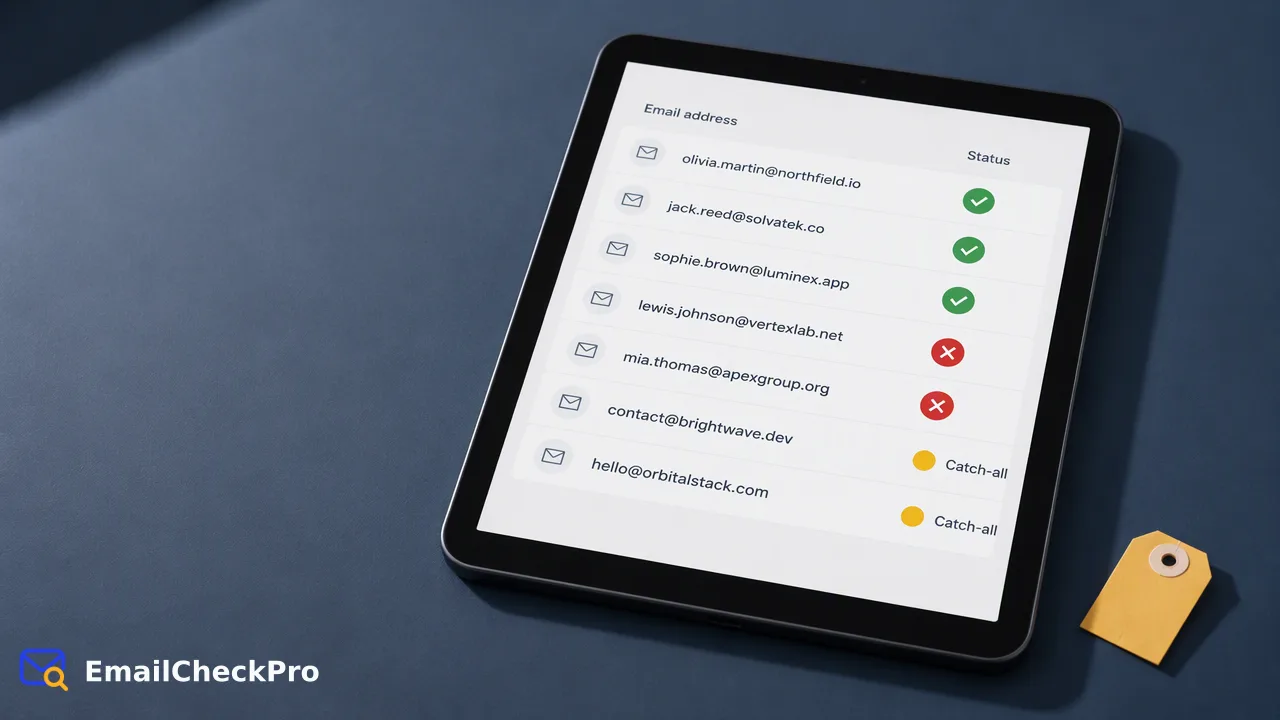
Relying on opaque AI sales agents creates deliverability risks. Learn why organizations must establish an independent data verification layer to evaluate address deliverability and audit lead quality.
Relying solely on automated platforms to source and contact prospects creates blind spots around AI sales agent data quality. Many automated sales agents function as closed systems, generating prospect lists without exposing the underlying data verification methods or intermediate check results. When organizations do not own their verification layer, they pass unverified contact records directly into automated messaging sequences. Implementing an independent verification layer gives teams direct oversight of contact hygiene before campaigns run. By testing addresses for deliverability at the moment of ingestion, teams obtain a clear signal of whether an account can receive mail, helping organizations filter out undeliverable contacts and maintain control over their pipeline data.
The Black Box Problem in AI Sales Automation
Automated sales platforms and artificial intelligence agents have emerged as a widespread category for outbound prospecting and prospect research. These tools combine contact discovery, personalization, and automated sending into single end-to-end workflows. However, many systems operate as opaque platforms that do not disclose how contact data is acquired, refreshed, or validated.
Relying entirely on proprietary, gated data sources introduces substantial operational risk. Because these tools bundle data generation and outbound dispatch into one closed loop, users cannot inspect or audit data quality prior to sending. When automated systems use static databases or stale scraping methods, they compile inactive or syntactically flawed addresses. Taking ownership of the data pipeline separates lead discovery from verification, providing an objective checkpoint between prospective contact generation and outbound messaging.
Why Teams Must Own the Verification Layer
Establishing an independent verification stage ensures that contact data meets predefined hygiene standards before any automated sequence initiates. Instead of trusting an opaque agent score, teams can evaluate addresses against direct deliverability checks.
Operating a dedicated verification step also aligns data workflows with regulatory expectations, such as data minimization principles under GDPR Article 5 (Regulation (EU) 2016/679), which requires personal data to be adequate, relevant, and limited to what is necessary. Filtering out invalid or non-existent contacts prevents organizations from accumulating and processing obsolete personal data. Maintaining an external, controllable verification layer provides an observable record of list health, giving operations teams verifiable inputs rather than unverified platform assumptions.
Navigating Catch-All Domains and Undetermined Results
A common challenge in evaluating AI sales agent data quality is managing catch-all mail servers.
Under EmailCheckPro, catch-all domains return an undetermined result rather than an inferred deliverable or undeliverable label. Recognizing undetermined records as a distinct category prevents automated workflows from treating uncertain data as confirmed contacts. Operational teams can establish internal handling rules for undetermined addresses, such as routing them to manual research or supplementary validation steps, while immediately discarding confirmed undeliverable records. Respecting the standard address structure defined in RFC 5322: Internet Message Format alongside transparent domain-level feedback helps organizations build reliable data segmentation criteria across their prospect databases.
Integrating Deliverability Checks into Pipeline Workflows
Integrating independent verification into outbound operations requires embedding check points at specific stages of the data pipeline. Teams should configure deliverability evaluations immediately after an AI sales agent outputs a contact list, but before those contacts enter active sequence queues.
Verification can be deployed through multiple operational patterns depending on list volume:
- Single-address checks: Evaluate individual records on demand as prospect accounts are surfaced.
- Synchronous batch checks: Process batches of up to 100 addresses at once during import tasks.
- Asynchronous bulk tasks: Submit large address files formatted as plain TXT or CSV files with one address per line.
Establishing these verification gates creates a systematic filtering mechanism. Addresses confirmed as deliverable can move to queue staging, confirmed undeliverable addresses are removed, and undetermined catch-all addresses are flagged for team review. This structured workflow gives operations teams complete authority over the data entering their outbound systems.
FAQ
What does a deliverable result indicate about an email address?
How should teams handle catch-all domains in automated lead lists?
Teams should avoid assuming undetermined contacts can receive mail. Instead, organizations can isolate undetermined records for secondary review or manual validation workflows, ensuring that only records with confirmed deliverability pass automatically into active outbound pipelines.
Why should teams verify addresses independently instead of relying on an AI SDR?
AI sales agent platforms frequently package data generation and outreach into an uninspected workflow, obscuring data verification methodologies. By maintaining an independent verification layer, teams gain direct visibility into address deliverability before messages are dispatched. Independent checks provide an objective deliverability signal, allowing organizations to audit list quality, filter non-existent mailboxes, and control their outbound data pipelines.
Learn More
Choose the product information that fits the next step in your workflow.